
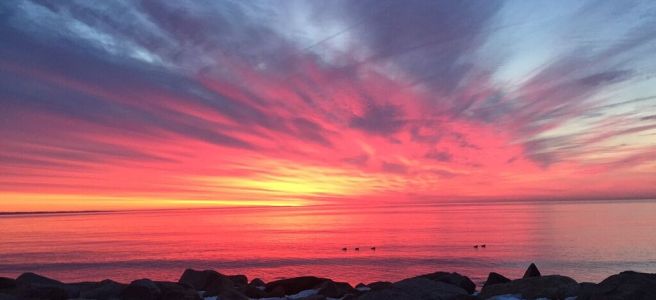
In honor of those of you who head “home” for the holidays, I’ve been doing some thinking about the intersection of geography, memory, and (of course!) writing.
I spent most of my childhood in a very small town, where the landscape became deeply familiar and where very little changed over the years. I knew the houses around every corner, the best hills for sledding, and the secret, wooded places to hide out in my neighborhood. I navigated by using my friends’ houses or our schools as markers; I navigated by beaches and by parks, by the distance a new location was from one I already knew.
Going home after years spent away is a little like that old French saying, “The more things change, the more they stay the same.” The landscape has definitely changed: trees cut down, portions of the shoreline beaches eroded or changing shape, new developments popping up in what used to be cornfields or wooded space.
The high school has a new edition, although the smaller brick box maze I attended is still in place. The bookstore where I fell in love with reading just celebrated its 25th anniversary. The ice cream shop I visited in childhood has been replaced with another, and my favorite tea house has changed locations three times. There are food trucks that park near the town green now, and next to the green, the elementary school my childhood friends attended, the one whose doors I walked through for our graduation processional, sits empty. But behind that building is the field I played softball on for eight years, and the swings I used to swing on at 10 o’clock at night, after getting ice cream from a shop that no longer exists (because, small town. We got creative with our fun.).
I sat on those swings with a dark haired girl I no longer talk to, who has her Ph.D. now and a family I don’t know, on the night before I left for college. I swung on those swings with a girl who was the soul equivalent of a firecracker, swinging higher and higher, laughing and yelling and crying, the night of our friend’s wake. I stood by those swings for a half a dozen Fourth of July celebrations when the whole town turns out for the Concert on the Green. I stood by those swings when I glimpsed my crush, returned from Europe and looking like all the sharp edges the world has to offer. I stumbled to those swings after I chickened out on my first kiss, pulling away from the soft brush of lips and mumbling something about having to find…my sister? My friend? Somewhere (anywhere) else to be at that moment?
My husband teases me because as we drive through my town now, I tell the same stories over and over: that’s the temple where my sister played Esther for Purim, this is the waterfall we would pass on our way home from church every Sunday, be careful at this intersection because the oncoming traffic doesn’t stop and once my brother was in a really bad accident here, this is the gazebo where I spent an entire summer of humid nights, hanging out with my best friends.
My map of home is memory, even if no one else in the world could plot the same course. In ‘A Moveable Feast’, Ernest Hemingway wrote, “There is never any ending to Paris, and the memory of each person who has lived in it differs from that of any other. We always returned to it no matter who we were or how it was changed…”
Geography and memory inspire our creative processes. We visit our old favorite places, drive on familiar roads, and it reminds us of people, feelings and experiences we don’t always think about, those that have been eroded or erased from the maps of our lives now. Whether we use these details of place to build something new or simply to try to share our memory maps with others, we’re inspired to create a written landscape.
Happy holidays, and happy writing.
Today’s Prompt: Create a map, in words, from memory. Start at your parents’ home, or your home, or any favorite or least favorite place, and take your reader for a walk.
Your map could be plotted with all the places/things that are no longer there (friends moved away, trees cut down), or by specific memories (the room you first tasted ice cream, the yard where you drank out of the garden house, the driveway where your brother almost got hit by a car).
 southcountywriters